

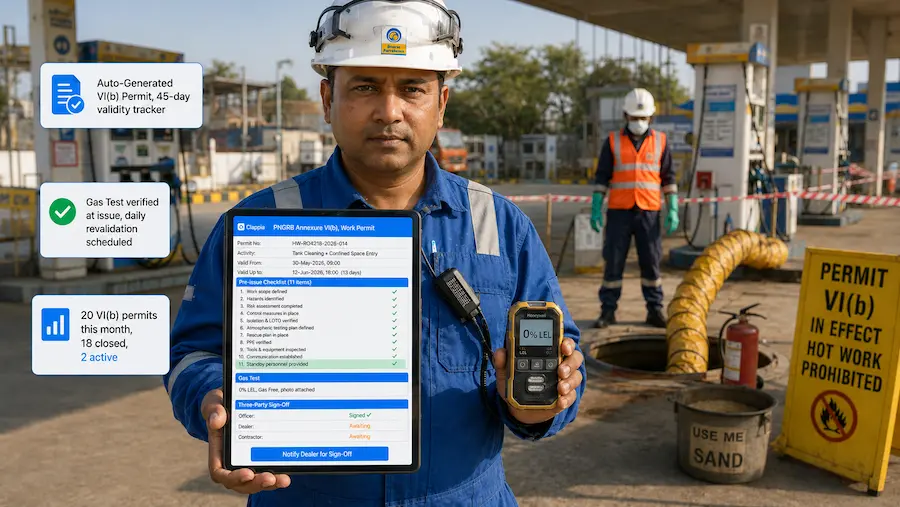
PNGRB Schedule 1 splits work permits into two formats. Annexure VI(a) is the one a dealer or RO manager can issue for low-risk jobs. Annexure VI(b) is the one only a company-authorised oil company officer can issue, for the 12 highest-risk activities at a petroleum retail outlet: hot work, tank cleaning, confined space entry, hazardous-area electrical work, excavation beyond 1 metre, and more. The format is stricter, the checklist is longer, and the consequences of getting it wrong are bigger. This article walks through every activity it covers, the 11-point pre-issue checklist, the three-party sign-off, and how a Clappia PNGRB audit checklist app turns the paper permit into a digital approval workflow with gas-test evidence and traceable closure. For the wider stack, see the parent PNGRB audit checklist guide.
Annexure VI(b), titled "Work Permit (For issue by Officer of the Oil Company)", sits inside Schedule 1 of the PNGRB Technical Standards and Specifications including Safety Standards (T4S) Regulations. It is the format mandated for any non-routine maintenance work at a petroleum retail outlet that exceeds the dealer's authority.
The format has six blocks. Header block: company name, outlet name, permit serial number, date and time of validity from and to (max 45 days). Permission block: name of the section or contractor receiving permission. Nature and location block: detailed description of the work and the specific area inside the RO. Pre-issue checklist block: 11 mandatory checks the officer must tick before signing, including the 5 from VI(a) plus 6 additional checks specific to high-risk work. Special instructions block: PPE selection, fire alert protocol, toxic chemicals, alternate escape route, permit availability. Three-party sign-off block: distinct signatures from the oil company officer, the dealer / authorised manager, and the contractor / authorised supervisor, each accepting their own role.
The difference is risk class, issuer authority, and procedural depth. Here's the side-by-side.
| Aspect | Annexure VI(a) | Annexure VI(b) |
|---|---|---|
| Issuer | Dealer, RO Manager, or operator | Company-authorised oil company officer ONLY |
| Activities covered | 10 low-risk activities (signage, canopy access, forecourt repair, etc.) | 12 high-risk activities (hot work, tank cleaning, confined space, etc.) |
| Validity | Per job, until "Nature of Work" is complete | Maximum 45 days, re-issue required after |
| Pre-issue checklist | 5 items | 11 items (includes gas test, water flush, standby personnel) |
| Signatories | Two: issuer + receiver | Three: oil company officer + dealer + contractor |
| Gas test before work | Not required | Required, must be gas-free |
| Closure | Closure signature by issuer + contractor | Closure tied to work completion under "Nature of Work", three signatories notified |
These are the only activities that require an oil company officer's sign-off. A dealer cannot authorise any of these. Misclassifying one of these as a VI(a) job is one of the most common TPIA audit findings across Indian petroleum networks.
| # | Activity | What it typically involves |
|---|---|---|
| a | Repair / rework / cleaning of tanks and pipeline work | Any work on the underground tank shell or its pipeline network. |
| b | Tank removal and decommissioning | Decommissioning a UST, evacuating residual product, cleaning, lifting out. |
| c | Non-routine maintenance / replacement / major electrical work within hazardous area | Anything more than basic intrinsically-safe equipment work (which falls under VI(a)). |
| d | Entry into oxygen-deficient / inert-gas area | Confined-space entry into a purged tank or pit, requires standby personnel. |
| e | Pneumatic / hydrostatic pressure testing | Pressure-testing pipelines or vessels after repair or installation. |
| f | Cleaning of oil interceptor, oil/water separator | De-sludging, removal of accumulated product/water mix from the interceptor. |
| g | Hot work: welding, grinding, gas cutting | Any open-flame or spark-producing equipment use anywhere in the RO. |
| h | Demolition and revamping (remodelling) | Any structural work on the canopy, sales building, or major civil change. |
| i | All activities capable of producing a spark inside a hazardous area | Power tools, grinders, even a non-FLP electric drill in Zone 1 or Zone 2. |
| j | Excavation including forecourts exceeding 1 metre depth | Anything deeper than 1 m. Shallower excavation falls under VI(a). |
| k | Concrete cutting in the hazardous zone | Cutting forecourt concrete near a dispenser or fill point. |
| l | Setting up temporary equipment (compressor, water/sand blasting, product recovery) | Bringing in non-permanent powered equipment, e.g. for tank cleaning. |
This is where VI(b) gets stricter than VI(a). The officer cannot sign until each of these is verified physically at the work site or marked "Not required" in writing.
| # | Pre-issue check | What the officer verifies |
|---|---|---|
| 1 | Equipment / work area inspected | Officer physically walks the area, not just signs from the office. |
| 2 | Surrounding area checked, cleaned, and covered | No product exposed in the work area. |
| 3 | Equipment electrically isolated and tagged | LOTO equivalent: isolation point physically tagged with the permit number. |
| 4 | Portable extinguisher and sand buckets provided | 9 kg DCP extinguisher and sand buckets positioned at the work site. |
| 5 | Sources of product / vapour blocked (blinded / disconnected / closed / isolated / wedge opened) | Specific isolation method written, not just "isolated". |
| 6 | Removal of left-over product from tank / pipeline / equipment | Critical for tank cleaning and pipeline work. No residual fuel. |
| 7 | Equipment water flushed | Standard practice before any hot work on previously fuel-containing equipment. |
| 8 | Pyrophoric iron removed / kept wet | Important for old tanks where iron sulphide can self-ignite on air exposure. |
| 9 | Proper ventilation and lighting provided | Forced ventilation for confined spaces, FLP lighting for hazardous areas. |
| 10 | Gas test done, found gas free | Explosimeter reading recorded, LEL 0%. Without this, no hot work proceeds. |
| 11 | Standby personnel provided | For confined-space entry, a trained standby person stays at the entry point. |
Three signatories, each accepting a distinct, written responsibility. The format spells out the role each signs into.
Oil company officer: "I have duly explained the nature of the work, risk involved, and all the safety precautions to be followed to the vendor and his supervisor for implementation, as well as to the Dealer and his authorised representative for monitoring the same. This permit shall be valid till the work as mentioned in 'Nature of Work' is completed."
Dealer or authorised manager: "I have understood the risk involved and the safety precautions explained to me by the Oil Company Officer and I shall monitor the work in accordance with the same till the work as specified under the 'Nature of Work' is completed."
Contractor or authorised supervisor: "I have understood the risk involved and the safety precautions explained to me by the Oil Company officer and I shall carry out the work in accordance with the same, till the work as specified under the 'Nature of Work' is completed."
Three signatures, three written undertakings. A digital permit captures each role with its declaration text, the signatory's name, designation, and digital signature, with the timestamp of each acceptance.
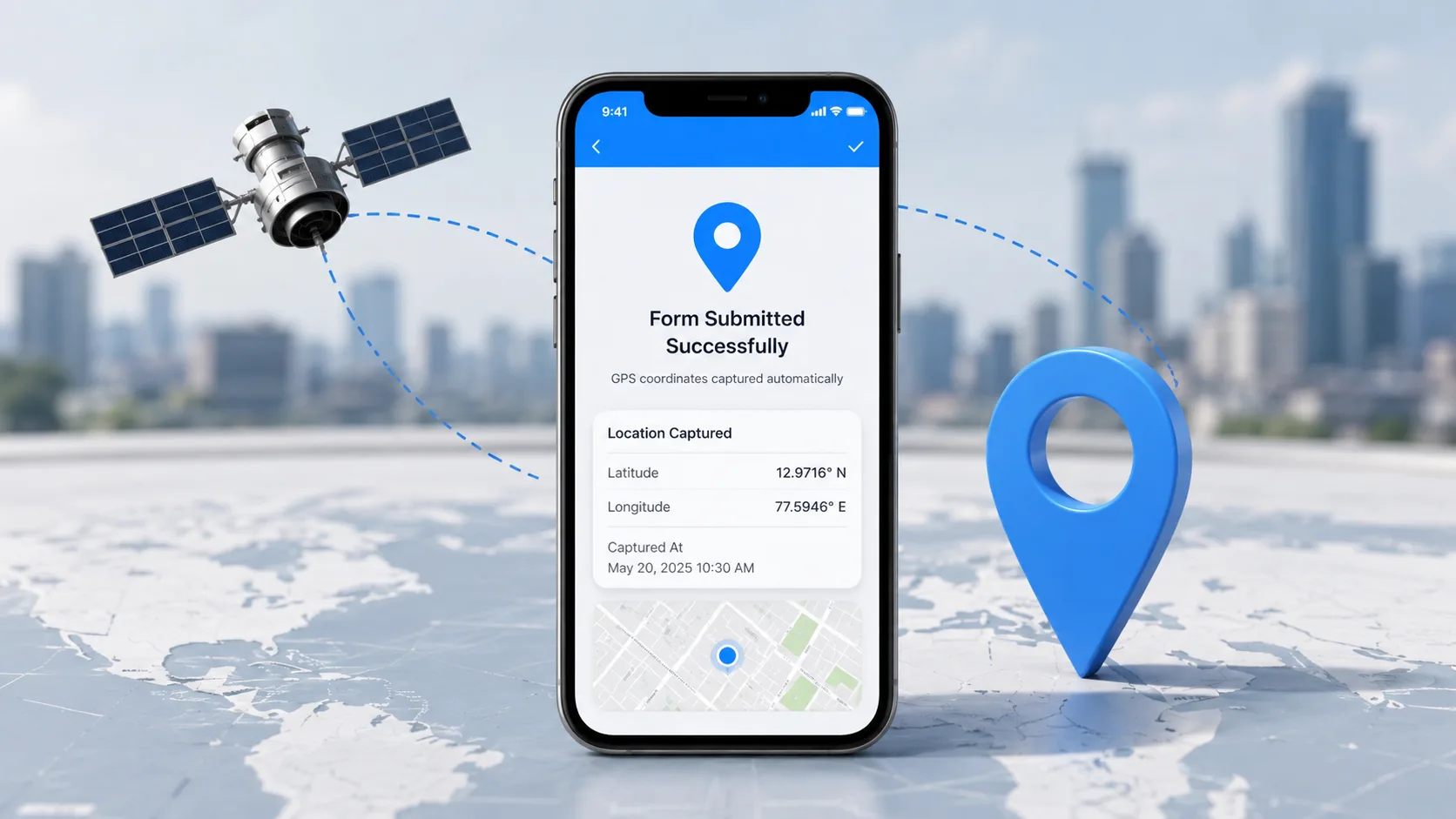
Identity and context: company name, retail outlet code and address, permit serial number (auto-generated sequential, prefixed with the activity class), date and time valid from, date and time valid to (with a hard validation that the gap does not exceed 45 days), GPS coordinates of submission.
Issuer details: oil company officer name, employee ID, designation, region, digital signature, timestamp.
Work scope: activity class (dropdown from the 12 VI(b) activities, with conditional logic flagging extra checks for tank cleaning, confined-space, and hot work). Detailed description of the work. Specific location inside the RO (dropdown from outlet's master location list).
Pre-issue checklist: 11 toggles for the 11 regulatory checks, mandatory photo evidence for the area inspection, equipment isolation tag, gas-test reading (with explosimeter reading in % LEL captured as a number), and standby personnel name where applicable. PPE multi-select, toxic chemicals free-text, alternate escape route status.
Dealer / monitor block: dealer or authorised manager name, designation, digital signature accepting the monitoring role, timestamp.
Contractor block: contractor company name, supervisor name and contact, list of crew members on site, digital signature accepting the execution role, timestamp.
Closure block: closure date and time, closure remarks (any incident, anything left in progress), closure photo of the work area, gas-test final reading where applicable, three-party closure signatures.
System-side fields: severity tag (Critical / Major) per permit type, link to the parent outlet's annual Annexure V audit, automatic daily revalidation reminder for multi-day permits up to the 45-day cap.
| Annexure VI(b) need | Clappia feature |
|---|---|
| Route permit ONLY to the company-authorised officer based on outlet's region | Approval workflows with role-based routing, dealer cannot self-approve |
| Activity dropdown that auto-classifies VI(a) vs VI(b) | Formula block with validation rule to enforce the correct format |
| Sequential permit number with activity prefix, e.g. HW-RO4218-2026-014 | Unique ID block with custom prefix per activity class |
| Hard 45-day validity cap on "valid to" field | Date selector with formula validation against "valid from" |
| Three-party sign-off: officer, dealer, contractor, with role declarations | Digital signature blocks, three separate fields, each with its declaration text |
| Gas test reading captured in % LEL, must be 0% to proceed for hot work | Number input field with min/max validation, blocking submission if non-zero |
| Photo evidence of equipment isolation tag, gas test meter, standby personnel | Camera and file upload block, mandatory before each signature |
| Auto-generated PDF in the Annexure VI(b) format, ready to post at work site | Print Settings templates that mirror the regulatory layout |
| Daily revalidation prompt for multi-day permits | Workflow timer node triggers a daily WhatsApp to all three signatories |
| Critical alerts (gas-test failure, isolation breach, standby absent) | WhatsApp, Slack, email, and SMS workflow nodes |
| Permit register for the annual Annexure V audit, sliced by activity, region, contractor | Live dashboards with filters by activity, status, days-open |
| Issue at outlets with poor connectivity | Offline mode by default on Android and iOS |
Build your PNGRB Annexure VI(b) work permit app on Clappia in minutes, with gas-test evidence, three-party sign-off, and 45-day validity tracking.
Get Started For FreeA VI(b) permit is a 45-day-max document covering multi-day, multi-shift, high-risk work. Without a system, the paper version moves between the officer's car, the dealer's drawer, and the contractor's site bag, and someone forgets to sign the closure.
Permit drafted: a contractor or site engineer raises a permit request on the app with the activity class and work scope. The system auto-flags it as VI(b) and routes it to the regional oil company officer. The officer reviews on a phone or tablet, visits the site, completes the 11-point pre-issue checklist (with photos for gas test, equipment isolation, ventilation, standby personnel), and signs digitally.
Permit issued: the dealer receives a WhatsApp notification, opens the permit, reads and accepts the monitoring declaration, and signs. The contractor receives a notification, reads and accepts the execution declaration, and signs. Only then does the permit move to "Active". The PDF is auto-generated and accessible to all three parties.
During work: for permits with validity longer than 24 hours, a daily revalidation prompt at the start of each shift asks the officer (or the officer's deputed person on-site) to re-verify the conditions are still met. Any "No" answer suspends the permit and pages the officer.
Closure: contractor uploads closure photo and signs. Dealer signs the closure block. Officer signs the closure block. The PDF regenerates with the closure section filled, and the permit moves to "Closed" in the dashboard. If the 45-day cap is reached without closure, the system blocks any further work under that permit and forces a re-issue.
A regional safety officer at an oil marketing company manages high-risk maintenance across 240 retail outlets. About 15 to 20 VI(b) jobs per month: tank cleaning, hot work on dispenser swap-outs, excavation for new fuel line runs, oil interceptor cleaning. Before going digital, the officer drove to each site to sign paper permits. Multi-day permits often had the closure block blank because the officer was at another site when the work finished.
After moving to the Clappia template, contractors and dealers raise requests from a phone. The system routes each to the officer with the activity class pre-flagged. The officer reviews photos of the work area, equipment isolation, and gas-test meter remotely, then drives to site only for the final pre-issue verification visit. Three-party signatures happen on three phones. Daily revalidation prompts go out automatically. Closures are signed before the contractor leaves the site, because the system blocks site demobilisation until closure is signed by all three parties. At the next annual Annexure V audit, the VI(b) permit register has a 100 percent closure rate, with photos and signatures attached.
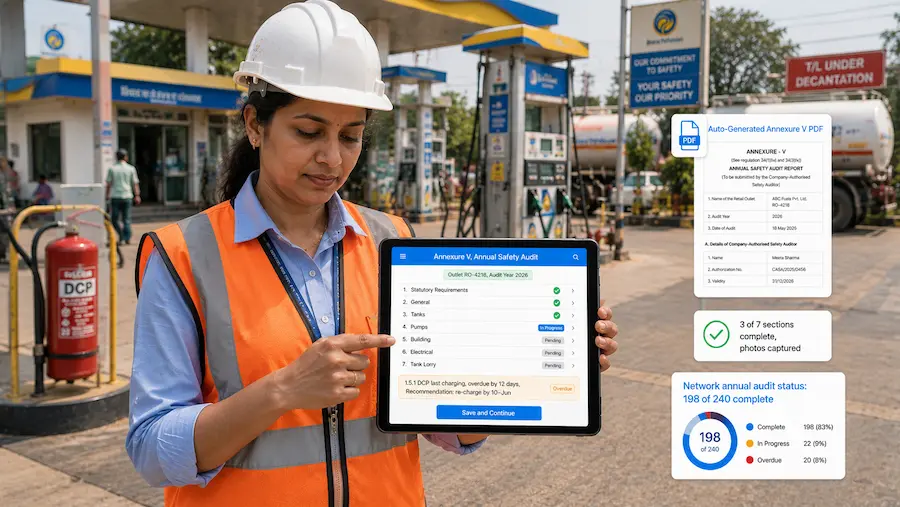
The company-officer work permit is the high-risk half of the Annexure VI dual-format system. Use it alongside the PNGRB Annexure VI(a) operator work permit for low-risk jobs the dealer can authorise; the PNGRB Annexure V annual safety audit checklist, whose Section 1 reviews the year's permit register; the PNGRB Annexure IV electrical audit checklist for the three-yearly deep electrical scope; the PNGRB Annexure III weekly inspection checklist that catches housekeeping issues created by permitted work; and the PNGRB Annexure VII tank-truck decantation checklist for fuel deliveries. The parent PNGRB checklist guide ties every annexure together.
Only a company-authorised officer of the oil marketing company (IOCL, BPCL, HPCL, Reliance, Nayara, Shell, etc.). The dealer, RO manager, contractor, or anyone else cannot issue this permit, even in the officer's absence. If urgent work cannot wait, it cannot proceed without the officer.
45 days. The regulatory format explicitly states: "THIS PERMIT SHALL BE VALID FOR THE ABOVE SPECIFIED PERIOD NOT EXCEEDING 45 DAYS." Work continuing beyond 45 days requires a fresh permit with a fresh pre-issue checklist.
Yes. Item 10 of the VI(b) pre-issue checklist requires a gas test to be done with the result "found gas free" recorded before signature. For hot work, the explosimeter reading must be 0% LEL. A non-zero reading blocks the permit from being issued.
Yes. Item d on the activity list is "Entry into oxygen-deficient / inert-gas area", which includes any tank entry, deep manhole chamber, or purged vessel. The permit requires standby personnel (item 11 of the pre-issue checklist) and ventilation (item 9).
No. The permit must be signed by all three parties (officer, dealer, contractor) BEFORE any hot work begins. The pre-issue checks are tied to the time of issue and the area state at that time. Starting work without three-party sign-off is a critical TPIA audit finding.
A fresh permit must be issued, with a fresh pre-issue checklist verified at the new issue time. The new permit gets a new serial number. The old permit closes with a "carried forward" note. The regulation does not allow extension or roll-over of the same permit beyond 45 days.
The hot work permit is the highest-stakes routine on the PNGRB stack. Three signatories, an 11-point pre-issue checklist, gas test evidence, 45-day validity, and multi-day site work all live or die by the discipline of the paper trail. Paper makes every step harder. A digital workflow makes the issuer's job remote-first (pre-verification by photo, on-site visit only for final check), the dealer's monitoring traceable, and the contractor's execution auditable end to end.
Ready to run Annexure VI(b) with three-party traceability? Sign up for free and build your hot work permit app on Clappia in under 10 minutes. No credit card, no contracts, no risk, just results.
 Get Started – It’s Free
L374, 1st Floor, 5th Main Rd, Sector 6, HSR Layout, Bengaluru, Karnataka 560102, India
3500 S DuPont Hwy, Dover,
Kent 19901, Delaware, USA


.svg)




3500 S DuPont Hwy, Dover,
Kent 19901, Delaware, USA
L374, 1st Floor, 5th Main Rd, Sector 6, HSR Layout, Bengaluru, Karnataka 560102, India
.avif)

%20(1).png)

.avif)