

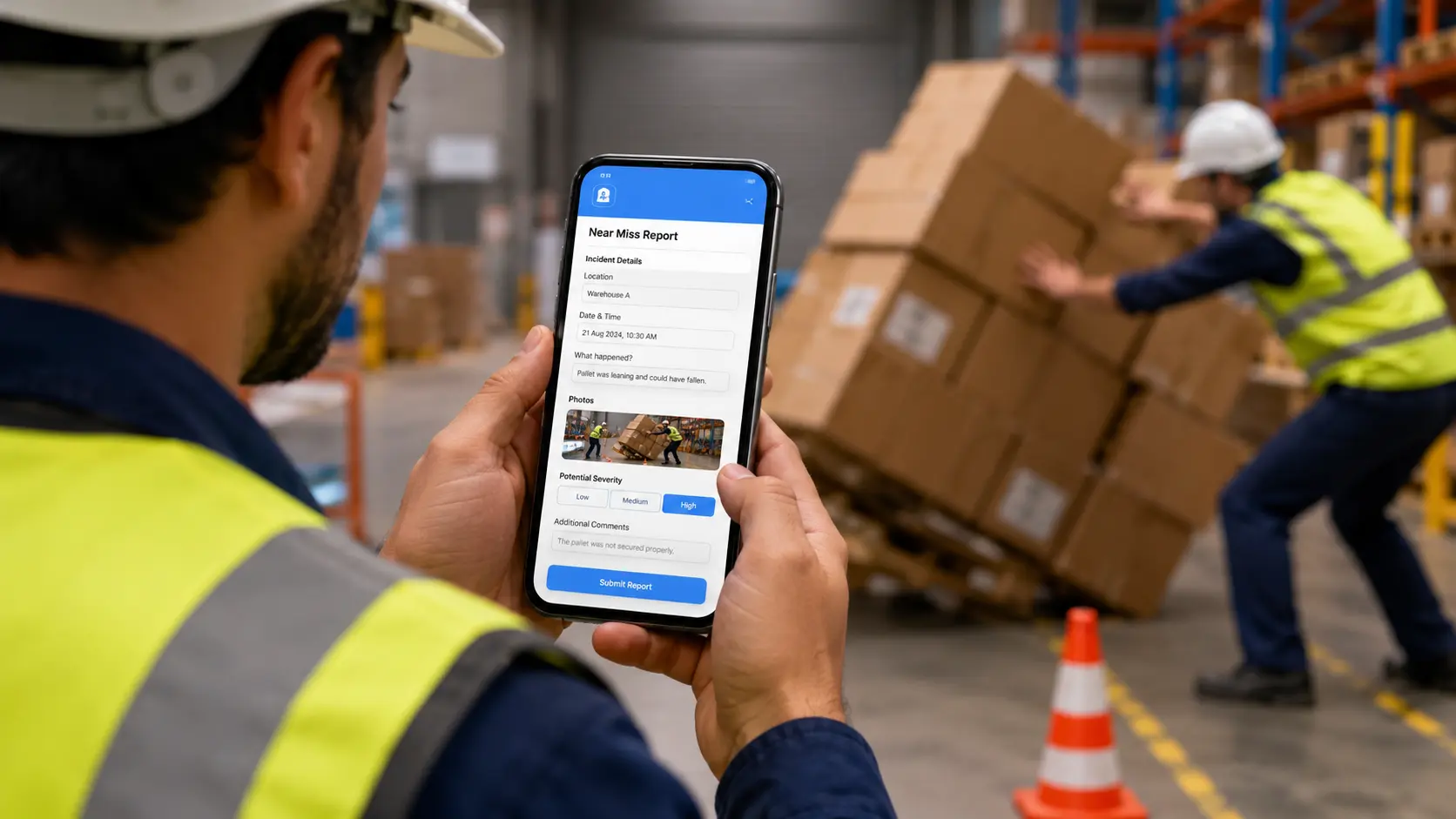
A forklift rounds a blind corner and stops inches from a worker who stepped out at the wrong moment. No one is hurt, so everyone exhales and gets back to work. That pause — the close call no one writes down — is a near miss, and it is one of the most valuable safety signals a workplace ever gets. Ignore it, and the next forklift may not stop in time.
This guide explains what a near miss is, how it differs from an incident or an accident, real examples across industries, why reporting matters, and exactly how to report one so the hazard actually gets fixed.
A near miss is an unplanned event that could have resulted in injury, illness, or property damage but did not — either by luck or by timely intervention. It is sometimes called a close call, a near hit, or a good catch. The defining feature is simple: the hazard was real, but the harm did not happen this time.
That "this time" is the point. A near miss is the same chain of events as an accident with the final, damaging link missing. Treating it as a free warning — rather than a non-event — is what separates a reactive safety program from a proactive one.
The three terms are often used interchangeably, but they describe different points on the same timeline. Getting the distinction right is what makes reporting consistent.
| Term | Harm occurred? | What it is | Why it matters |
|---|---|---|---|
| Near miss | No | A close call that could have caused harm but didn't | The earliest warning — lets you act before an injury |
| Incident | Sometimes | An unplanned event that disrupts work; may cause minor harm | Shows a hazard has already produced a consequence |
| Accident | Yes | An event that causes injury, illness, or damage | The outcome you're trying to prevent |
In short: a near miss is a warning, an incident is the event, and an accident is the version with real harm. A strong safety culture captures all three — but leans hardest on near misses, because they are the only category that lets you act before anyone is hurt.
Near misses look different in every environment, but they share a pattern: a hazard was present and harm was narrowly avoided. Here are common examples by setting.
| Setting | Near miss example | Hazard it exposes |
|---|---|---|
| Construction | A tool falls from scaffolding and lands where no one is standing | Unsecured tools at height |
| Manufacturing | A machine guard is found missing before anyone reaches in | Inadequate machine guarding |
| Warehouse | A forklift stops inches from a worker at a blind corner | Poor traffic separation / visibility |
| Healthcare | A near medication error is caught before administration | Unclear labeling or handoff |
| Office | Someone slips on a wet floor but catches the railing | Unmarked spill / missing signage |
Notice that none of these required an injury to be worth reporting. Each one exposes a fixable condition — a spill, a missing guard, a blocked exit, a rushed handoff — that would otherwise wait quietly for the day it finally causes harm.
Near misses are early warnings, and they are far more common than actual injuries. A long-standing principle in workplace safety holds that for every serious injury there are dozens of minor ones and hundreds of near misses beneath them — a pyramid of warnings that precede most incidents. Safety authorities such as the U.S. Occupational Safety and Health Administration (OSHA) and the Canadian Centre for Occupational Health and Safety (CCOHS) stress investigating near misses precisely because they reveal the conditions that lead to injuries, without the cost of one.
Reporting near misses lets a team:
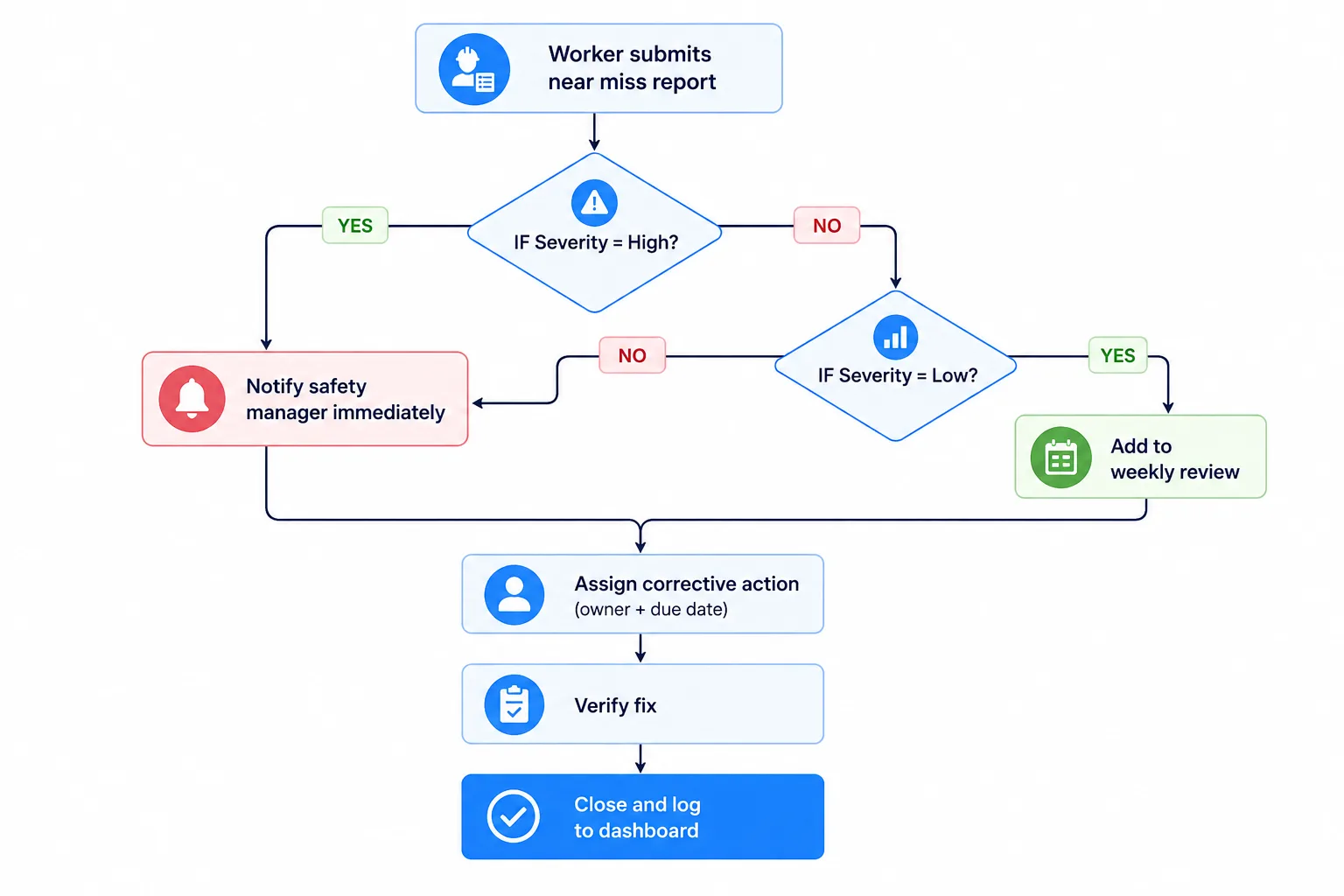
An effective process is short enough that a busy worker will actually complete it, and structured enough that nothing gets lost. It follows five steps.
The two failure points are the first and last steps: if reporting is slow or feels risky, the near miss never gets logged; and if there is no owner and due date, a logged report never turns into a fix. A good system removes friction at both ends. For a deeper walkthrough, see our guide on how to improve the near miss reporting process.
A useful near miss report is specific and blame-free. It should capture:
Crucially, a near miss report names conditions, not culprits. The moment reporting is used to assign blame, the reports stop — and the warnings go with them.
Most near misses go unreported for predictable reasons. Each has a practical fix:
The barriers above are mostly friction problems, which is exactly what a purpose-built app removes. With a no-code incident and near miss reporting app, a worker captures the hazard in under a minute, and the report routes itself to the right person with a due date attached. Because the app works fully offline, it holds up on remote sites and syncs when signal returns — and the camera and files block attaches a geo-tagged photo so the location and time are never in doubt.
From there, approval and corrective-action workflows assign an owner, send automatic notifications and PDF records, and a live dashboard tracks every open report to closure. Teams use the same approach for on-site hazard reporting, workplace inspections, quality inspections, and full safety incident reporting — or add AI with a no-code safety management app, all built without code.
The single biggest lever on near miss reporting isn't a poster or a policy — it's the time between spotting a hazard and having it logged. Get that under a minute, on the phone that's already in the worker's hand, and the reports show up on their own.
Turn every close call into a fix. Build a no-code near miss reporting app with photo capture, corrective-action workflows, and a live dashboard — free to start.
Get started free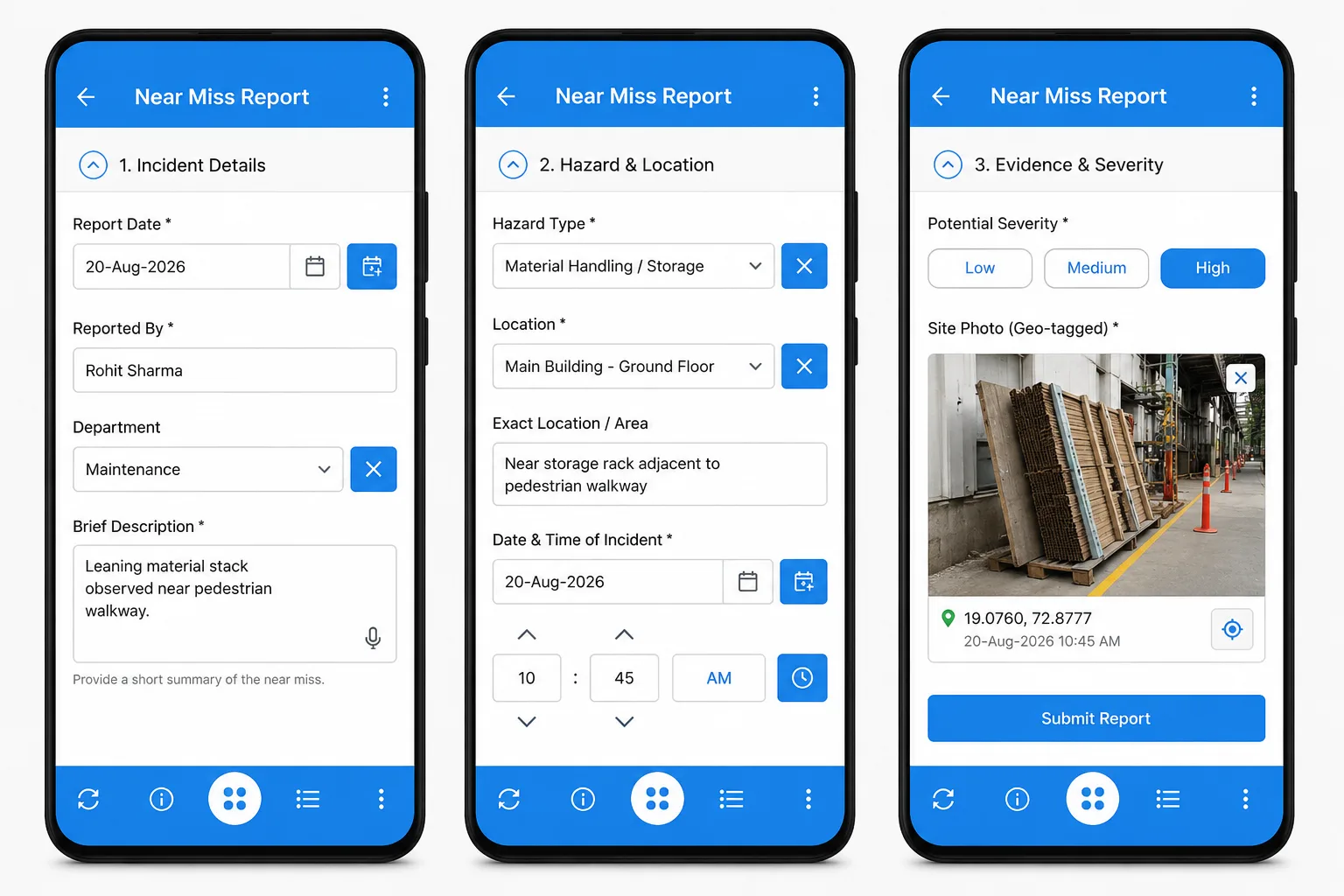
On a construction site, a worker notices a stack of materials leaning against a temporary barrier near a walkway. Instead of walking back to the site office, they open the mobile app, snap a geo-tagged photo, tag the hazard type and location, rate the potential severity, and submit — in under a minute, even with no signal. The report syncs automatically once they are back in coverage.
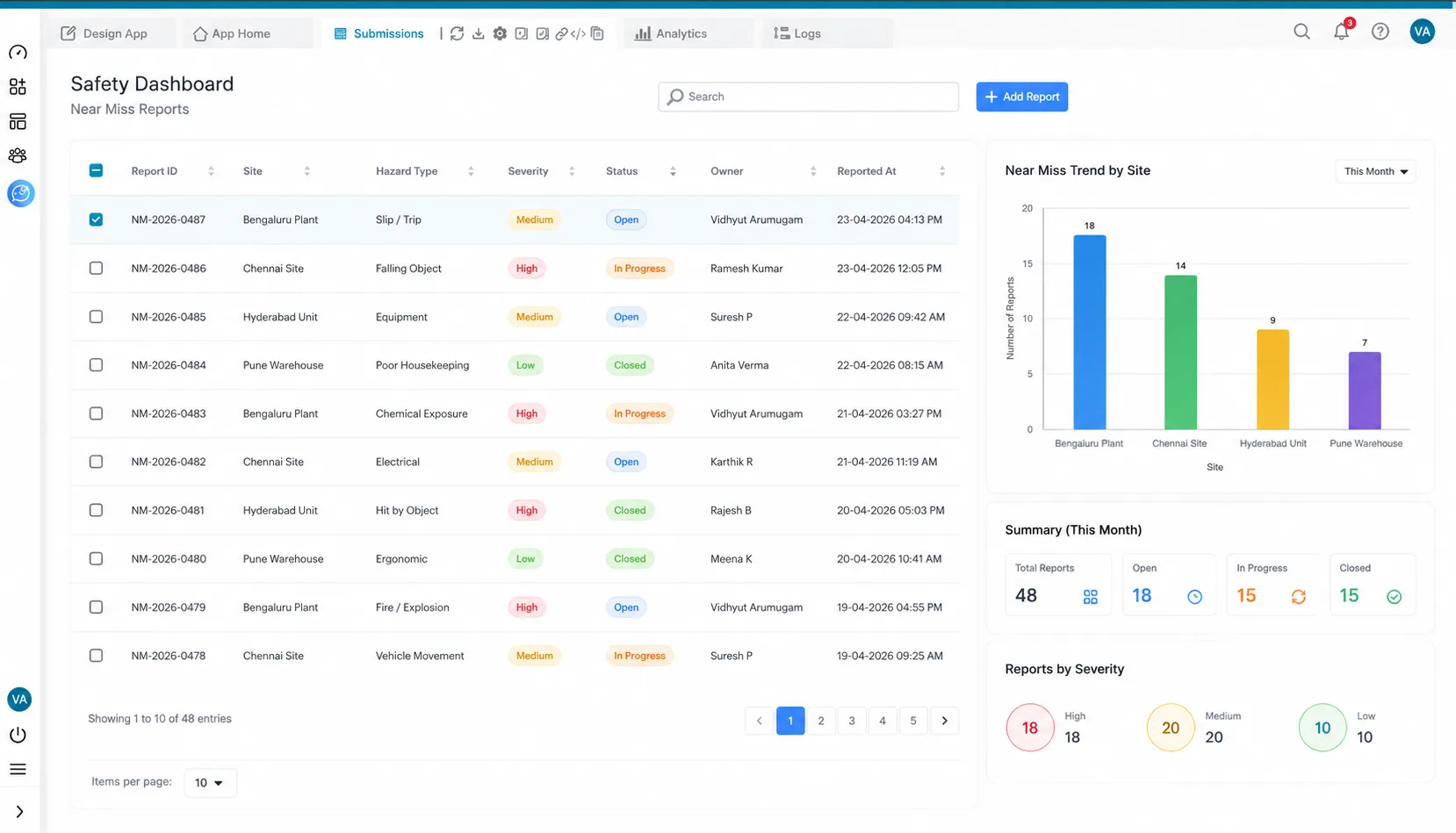
Back in the office, the safety manager opens a desktop dashboard showing every near miss by site, hazard type, and status. The new report has already been routed for corrective action with an owner and due date. They verify the fix, add a note, and mark it closed — and the trend chart updates, flagging that this walkway has now generated three near misses this month and needs a permanent change.
Ready to catch hazards before they become incidents? Start building for free and turn near miss reporting into a one-minute, mobile, blame-free habit — with photo capture, corrective-action workflows, and a dashboard that tracks every report to closure. Your team gets a safer site, and you get the warnings in time to act.
A worker slips on a wet floor but catches the railing and doesn't fall; a tool dropped from scaffolding lands where no one is standing; or a machine guard is found missing before anyone reaches into the machine. In each case a hazard was present and harm was narrowly avoided.
A near miss is a close call where no harm occurred, while an incident is an event that did cause injury, illness, or damage. The near miss is the same chain of events without the final damaging step — which is why it's such a useful early warning.
Because they reveal fixable hazards before those hazards cause an actual injury. Near misses are far more frequent than injuries, so acting on them is the most cost-effective way to prevent serious incidents and to spot patterns early.
Anyone who witnesses one — workers, supervisors, contractors, or visitors. The most effective programs make reporting easy for everyone and keep it blame-free, often with an anonymous option, so people feel safe raising a good catch.
The fastest way is a mobile app: capture a geo-tagged photo, tag the hazard and location, rate the potential severity, and submit in under a minute — even offline. The report then routes automatically to the right person for corrective action and is tracked to closure.
 Get Started – It’s Free
L374, 1st Floor, 5th Main Rd, Sector 6, HSR Layout, Bengaluru, Karnataka 560102, India
3500 S DuPont Hwy, Dover,
Kent 19901, Delaware, USA


.svg)




3500 S DuPont Hwy, Dover,
Kent 19901, Delaware, USA
L374, 1st Floor, 5th Main Rd, Sector 6, HSR Layout, Bengaluru, Karnataka 560102, India

.jpg)
.jpg)