


Modern businesses face mounting pressure to maintain optimal inventory levels while minimizing carrying costs and preventing stockouts. As supply chain complexity increases—from e-commerce retailers managing thousands of SKUs to manufacturers tracking raw materials and finished goods across multiple locations—the need for robust inventory tracking software becomes critical. Traditional spreadsheets, manual stock counts, and paper-based systems simply cannot keep pace with the dynamic requirements of modern inventory management.
Inventory tracking software designed for businesses enables systematic monitoring of stock levels, locations, and movements throughout the supply chain. From tracking product receipts and warehouse transfers to monitoring stock consumption and automating reorder alerts, the right platform transforms how businesses manage inventory operations. Clappia delivers a no-code solution that empowers operations teams to build custom inventory tracking applications tailored to their specific warehouse processes, product types, and business requirements.
Inventory tracking software encompasses the comprehensive monitoring and management of stock throughout its entire lifecycle—from initial receipt at warehouses through storage, movement between locations, consumption in production or sales, and final disposal or write-off. Effective inventory tracking connects physical stock quantities to digital records, provides real-time visibility into stock levels across all locations, automates reorder point notifications when inventory falls below thresholds, and maintains complete audit trails of all stock movements for accounting and compliance.
The complexity of modern inventory operations requires software that handles multiple variables simultaneously. Stock quantities must be accurate across dozens or hundreds of product variants, warehouse personnel need instant visibility into item locations for efficient picking, purchasing teams require advance warning before stockouts occur, and management needs aggregate visibility into inventory value and turnover rates. When inventory is poorly tracked, businesses face stockouts causing lost sales, excess inventory tying up working capital, shrinkage from theft or damage going undetected, and accounting discrepancies creating financial reporting problems.
Modern inventory tracking extends beyond simple stock counting. It integrates with point-of-sale systems and e-commerce platforms, automates purchase order generation based on reorder points, provides bin-level location tracking within warehouses, enables batch and serial number traceability for recalls, and offers predictive analytics forecasting future inventory requirements. The software becomes the operational nerve center where all inventory data converges, enabling proactive inventory optimization rather than reactive problem-solving.
Inventory management applications must deliver comprehensive capabilities that address stock control needs. Warehouse teams track inventory quantities in real-time across multiple dimensions—by product SKU, warehouse location, bin or shelf position, batch or lot number, and supplier. Real-time stock visibility eliminates uncertainty about product availability and reduces time spent searching for items.
Inventory dashboards provide instant visibility into current stock levels, highlight items approaching reorder points, show slow-moving inventory requiring attention, display fast-moving products requiring frequent replenishment, and enable drill-down from summary views into specific location and batch details. Warehouse managers, purchasing agents, and sales teams access the same real-time information ensuring coordinated inventory decisions.
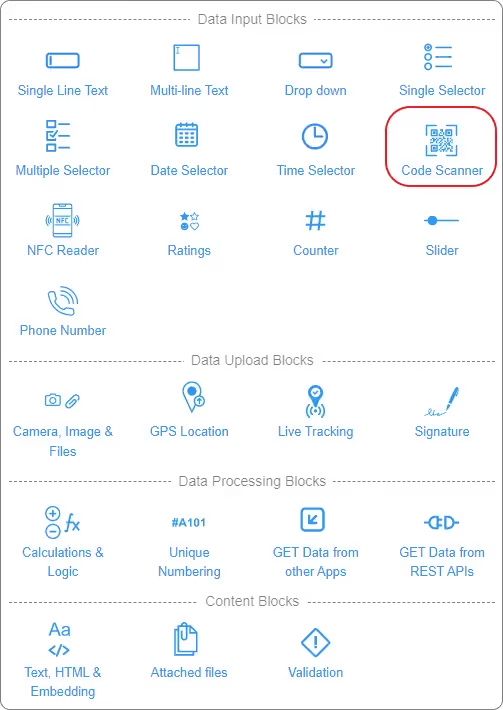
QR code and barcode scanning enables rapid, accurate inventory transactions. Warehouse personnel scan product barcodes during receiving to verify shipment contents, during putaway to record storage locations, during picking to confirm correct items, and during cycle counts to update quantities. Scanning eliminates manual data entry errors that plague spreadsheet-based systems.
Mobile barcode scanning accelerates warehouse operations dramatically. Receiving teams process incoming shipments in minutes rather than hours. Pickers locate items instantly using scan-to-verify workflows. Cycle counting becomes efficient enough for daily counts rather than quarterly disruptions. The accuracy improvements reduce inventory discrepancies from 5-10% down to under 1%.
Proactive inventory replenishment prevents stockouts while avoiding excess inventory. Workflow automation enables automatic reorder alerts when stock falls below minimum thresholds. Email notifications alert purchasing teams to items requiring reorder. Mobile push notifications send urgent alerts for critical stock items.
Automated systems calculate optimal reorder quantities based on historical consumption rates, lead times from suppliers, and target service levels. Purchase requisitions generate automatically with pre-filled supplier information, pricing, and delivery requirements. Purchasing agents review and approve rather than manually creating orders from scratch.
Businesses operating multiple warehouses, stores, or storage locations require consolidated inventory visibility. Multi-location tracking shows total available inventory across all locations, enables transfer orders moving stock between locations, identifies overstock at one location that could fulfill shortages at another, and provides location-specific reorder points accounting for local demand patterns.
Warehouse transfer workflows document stock movements with automatic inventory adjustments at both source and destination locations. Transfer documentation includes transfer dates, quantities, shipping methods, and receiving confirmations. Complete audit trails prove inventory movements for accounting and compliance purposes.
Traditional inventory management software often requires expensive licensing, lengthy implementation projects, complex training programs, and ongoing IT support. Many solutions lack flexibility for industry-specific requirements—whether fashion apparel managing sizes and colors, food distributors tracking expiration dates, or electronics retailers managing serial numbers. Clappia's no-code platform revolutionizes this approach by enabling operations teams to design and deploy custom inventory applications without writing code.
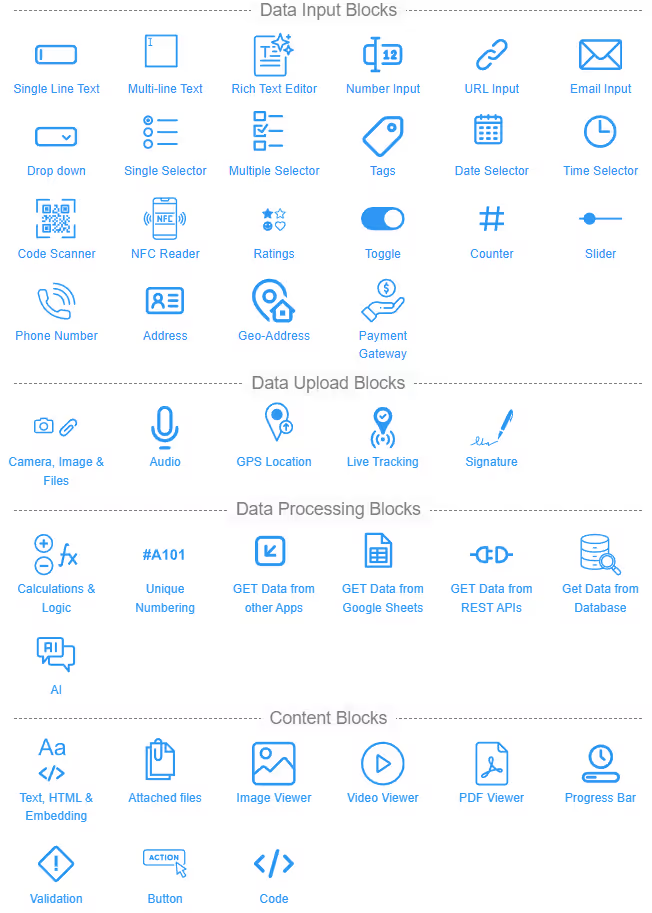
The platform provides pre-built blocks addressing inventory tracking needs. Single Line Text captures product SKUs and descriptions. Multi-Line Text records product details and notes. Drop Down selectors standardize product categories, warehouse locations, and transaction types. Number Input tracks quantities, costs, and pricing.
Date Selector records transaction dates, expiration dates, and reorder dates. Camera and file upload captures product photos, damage documentation, and receiving paperwork. Product images aid in identification during picking and receiving verification.

Formula blocks perform automatic calculations for inventory values, reorder quantities, days of supply, and turnover rates. These Excel-like formulas enable complex inventory logic without programming. Calculations include:
Unique ID generation automatically creates sequential stock transaction numbers, transfer order IDs, and cycle count batch numbers. Every inventory movement receives a unique identifier for perfect traceability.
Validation rules enforce data quality standards. Required fields prevent incomplete transactions. Numeric range validation catches quantity entry errors. Conditional logic shows relevant fields based on transaction type—receiving forms display supplier fields, transfer forms show destination locations, and consumption forms capture production order references.
Effective inventory tracking depends on accurate, timely data from warehouse floor operations. Mobile applications for Android and iOS deliver full inventory functionality on smartphones and tablets. Warehouse personnel conduct receiving inspections, record bin locations during put away, execute picking operations, and perform cycle counts—all without returning to desktop computers.
Offline mode functionality ensures inventory operations continue even in warehouses with poor Wi-Fi coverage or dead zones. Workers complete transactions offline with automatic synchronization once network connection resumes. This reliability is critical for large warehouses and facilities with thick concrete walls blocking signals.
Product traceability requirements vary by industry. Food and pharmaceutical companies track batch numbers for recall management. Electronics manufacturers track serial numbers for warranty service. Medical device companies maintain device history records linking serial numbers to patients.
Inventory applications capture batch numbers during receiving, link batches to expiration dates, track batch quantities separately within total inventory, and enable batch-specific picking for FIFO (First In, First Out) inventory rotation. Serial number tracking records each unit individually with complete transaction history from receipt through sale or disposal.
Visual documentation supports inventory accuracy and dispute resolution. Warehouse teams photograph damaged goods during receiving, capture before/after images during inventory adjustments, document storage conditions for perishable items, and record proof of shipment for outbound orders. Photos upload automatically to cloud storage with timestamps and GPS locations.

Inventory tracking must integrate seamlessly with sales channels. REST API integrations connect with Shopify, WooCommerce, Magento, and custom e-commerce platforms. Sales automatically reduce available inventory, stock levels synchronize bidirectionally preventing overselling, and low stock alerts trigger before products show as out-of-stock online.
Point-of-sale system integration updates inventory in real-time as products sell in physical stores. Multi-channel inventory visibility enables buy-online-pickup-in-store (BOPIS) fulfillment and ship-from-store capabilities.

Database integration enables direct connections to MySQL, PostgreSQL, and Microsoft SQL Server systems. Inventory transactions flow into ERP systems for financial reporting. Cost of goods sold calculations update automatically. Inventory valuations reflect actual stock quantities and costs. Purchasing data synchronizes preventing duplicate orders.
Supplier collaboration improves through vendor portals built on inventory systems. Suppliers view forecasted demand, submit quotations, confirm delivery schedules, and update shipment status. Purchase order management tracks orders from creation through receipt with automatic three-way matching of purchase orders, receiving documents, and supplier invoices.
Google Sheets synchronization provides flexible reporting and analysis. Daily inventory snapshots export automatically. Stock movement reports update in real-time. Custom inventory analysis leverages spreadsheet formulas and pivot tables. The flexibility supports both standardized dashboards and ad-hoc investigation.
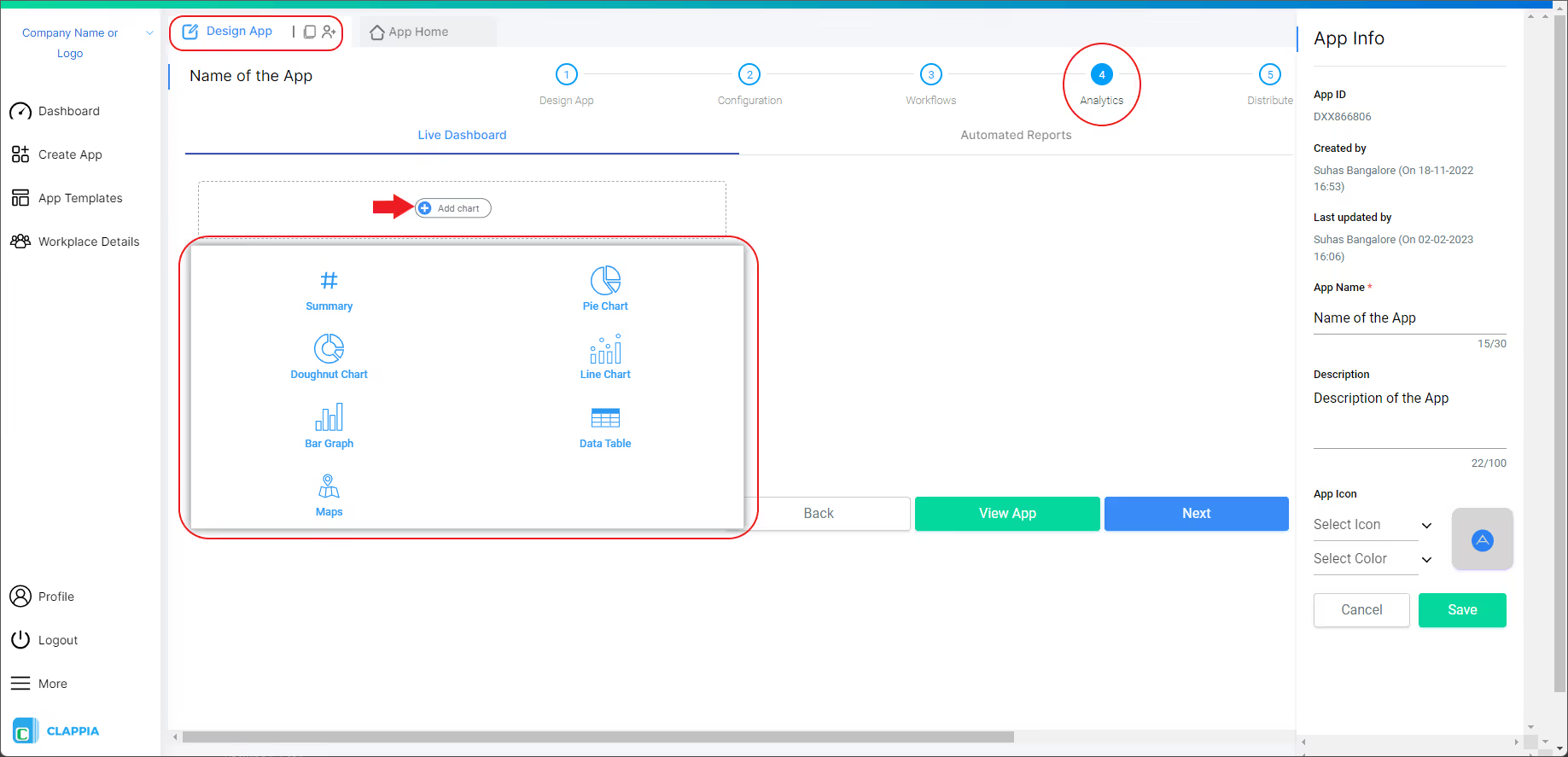
Inventory tracking software must provide instant visibility into operational and financial performance. Analytics dashboards display critical inventory metrics including total inventory value by category, stock turnover rates by product, items below reorder points requiring action, slow-moving inventory older than 90 days, stock accuracy rates from cycle counts, and fill rates measuring stockout frequency.
Bar charts, line graphs, and pie charts visualize inventory trends. Operations managers identify categories requiring investment or liquidation. Financial controllers monitor inventory as percentage of working capital. Purchasing agents track supplier performance on delivery reliability.
Automated reporting delivers scheduled inventory summaries to stakeholders. Daily stock status reports arrive automatically each morning showing current quantities and pending receipts. Weekly inventory movement reports aggregate receipts, shipments, and adjustments. Monthly valuation reports consolidate inventory values for financial close processes.
ABC analysis categorizes inventory by value and velocity. "A" items represent 20% of products generating 80% of value requiring tight control. "B" items need moderate attention. "C" items are low-value requiring minimal oversight. Inventory systems automatically classify products, recommend differentiated policies by category, and focus attention on high-impact items.
Efficient warehouses track inventory at bin-level granularity. Each storage location receives a unique identifier—row, rack, shelf, and bin position. During putaway, workers scan products and bin locations creating precise location records. During picking, workers receive bin locations minimizing search time.
Location optimization algorithms recommend put away locations based on product velocity, with fast-moving items near shipping areas and slow-moving items in deeper storage. ABC analysis informs location strategy maximizing warehouse productivity.
Perpetual inventory systems replace annual physical counts with ongoing cycle counting programs. High-value items count monthly, moderate items quarterly, and low-value items annually. Mobile cycle counting apps present count tasks, record actual quantities, highlight discrepancies exceeding thresholds, and trigger immediate investigation of large variances.
Inventory accuracy metrics track system accuracy by location, product category, and time period. Accuracy targets typically aim for 95% or higher measured as records within tolerance limits. Continuous improvement programs address root causes of inaccuracy—receiving errors, pick errors, damage, theft, or system issues.
Warehouse picking efficiency directly impacts order fulfillment speed and accuracy. Pick lists generated from inventory systems present items in optimal warehouse sequence. Barcode scanning confirms correct items and quantities. Pick-to-light and voice picking technologies integrate with inventory systems for hands-free operation.
Pack and ship verification prevents shipping errors. Workers scan items during packing comparing against order requirements. Weight verification catches quantity errors. Shipping label generation pulls data from inventory and order systems creating accurate documentation.
Growing businesses need inventory software that scales with operations. Clappia supports expansion from single warehouses to multi-facility distribution networks without platform changes. Centralized inventory visibility across locations enables coordinated stock allocation, inter-facility transfers optimizing inventory positioning, and consolidated purchasing leveraging volume discounts.
Retail chains and franchise operations require location-specific inventory while maintaining corporate visibility. Store-level inventory tracking enables local ordering decisions. Corporate dashboards aggregate inventory across all locations. Transfer capabilities balance inventory between under-stocked and over-stocked locations. White-labeled mobile apps provide branded inventory experiences for each franchise or store brand.
Global businesses manage inventory in multiple currencies and across international borders. Multi-currency support tracks inventory costs in local currencies while consolidating values in corporate reporting currency. International inventory accounts for customs duties, landed costs, and cross-border transfer documentation. Regulatory compliance features address country-specific inventory reporting requirements.
Implementing inventory tracking software doesn't require lengthy development projects or expensive system integrators. Clappia's no-code platform enables operations teams to start building immediately without specialized technical skills.
The drag-and-drop interface uses concepts that warehouse managers and inventory controllers understand intuitively. Pre-built templates provide starting points for inventory receiving, stock transfers, cycle counting, and reorder management. Customization transforms templates into solutions matching specific product types, warehouse layouts, and operational workflows.
Free plans support unlimited inventory applications, enabling businesses to build and test solutions before committing to paid features. As inventory complexity and transaction volumes grow, professional plans add capabilities like white-labeled mobile apps, increased transaction limits, and premium integrations. The pricing model scales with business growth, ensuring cost-effectiveness at every stage.
Video tutorials, comprehensive help documentation, and an active community forum provide assistance during implementation. Scheduled demos showcase inventory tracking capabilities and answer specific questions about warehouse operations and inventory optimization use cases.
Inventory tracking software transforms operations from reactive stock management to proactive inventory optimization. Real-time visibility into stock levels enables better decisions about purchasing quantities, warehouse capacity, and product discontinuation. Automation reduces manual counting and data entry effort while improving accuracy. Analytics reveal slow-moving inventory requiring clearance, fast-moving items requiring safety stock increases, and opportunities for supplier consolidation.
Clappia empowers operations teams to build custom inventory solutions matching unique business requirements. The no-code platform accelerates deployment while maintaining flexibility for continuous enhancements. Mobile-first design with offline support ensures usability in warehouse environments with challenging connectivity. Comprehensive integration connects inventory tracking with sales channels, accounting systems, and procurement platforms.
Businesses implementing intelligent inventory tracking gain competitive advantages through reduced inventory carrying costs through optimal stock levels, improved cash flow from reduced excess inventory, enhanced customer satisfaction from fewer stockouts, operational efficiency from faster warehouse operations, and data-driven inventory investment decisions. The investment in inventory digitalization pays dividends through lower working capital requirements, improved inventory turnover, and better service levels.
Explore Clappia's capabilities and discover how inventory tracking software can revolutionize your warehouse and stock management operations.
Start Building Today: Sign up for free and create your first inventory tracking application in minutes.


L374, 1st Floor, 5th Main Rd, Sector 6, HSR Layout, Bengaluru, Karnataka 560102, India
3500 S DuPont Hwy, Dover,
Kent 19901, Delaware, USA


.svg)




3500 S DuPont Hwy, Dover,
Kent 19901, Delaware, USA
L374, 1st Floor, 5th Main Rd, Sector 6, HSR Layout, Bengaluru, Karnataka 560102, India