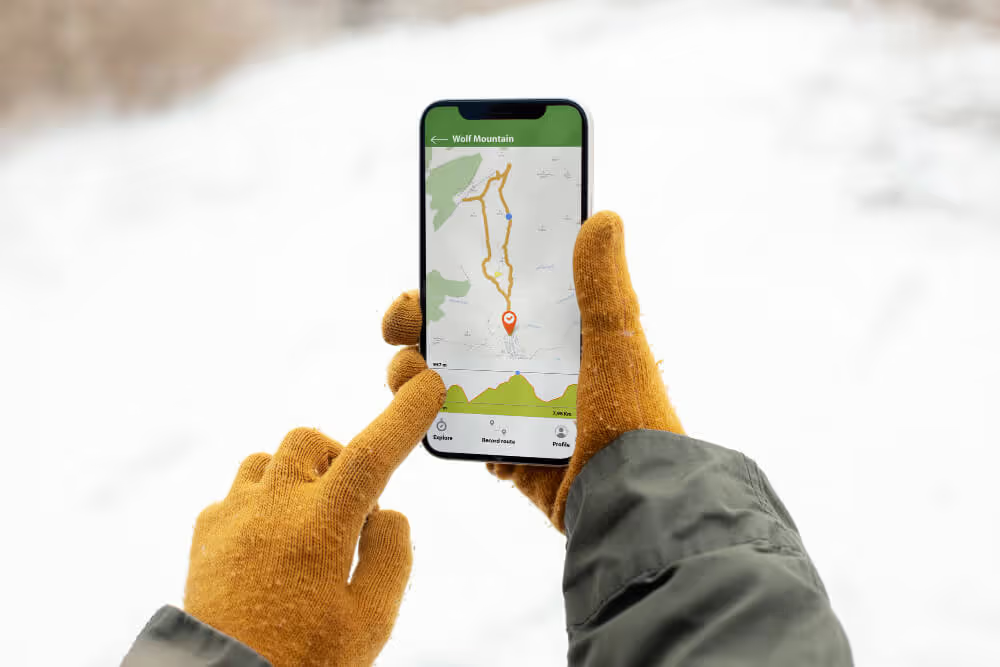


A plant safety manager opens her spreadsheet on a Monday morning and realizes the last fire extinguisher check at Site 4 happened four months ago, not four weeks. The paper binder that should have caught the gap was still sitting in a supervisor's truck two states away. Stories like this are becoming the norm rather than the exception, because the agencies and audit programs that used to catch these gaps are stretched thinner every year, and the paper systems many field teams still run on were never built to keep up. Here is what the numbers actually say about field inspections heading into 2026, and what is changing.
Federal OSHA conducted 30,273 inspections in FY 2025, split between 16,311 unprogrammed inspections (triggered by complaints, injuries, or referrals) and 13,962 programmed inspections (planned emphasis-program visits), according to OSHA's current enforcement summary. That volume looks steady on paper, but a group of US senators flagged a 20% drop in inspections between April and September 2025 compared with the same period in 2024, alongside a 42% drop in willful-violation findings over the same window.
Coverage is the real bottleneck. OSHA's own published statistics put federal and state inspectors at roughly 1,850 combined, responsible for 130 million workers across more than 8 million worksites. That works out to about one compliance officer for every 70,000 workers.
Federal staffing alone fell from 812 officers at the end of fiscal 2024 to 629 by September 2025, before an anticipated rebuild toward roughly 1,720 inspectors in 2026. When the ratio of inspectors to worksites keeps widening, internal field inspection programs, not government audits, become the main line of defense against a missed defect or an expired certification.
Digital adoption is no longer a pilot project. Deloitte's 2026 State of Digital Adoption in Construction report, based on a survey of 954 construction and engineering businesses, found mobile apps now in use at 47% of firms and construction-management cloud software at 50%, both up sharply from the first edition of the study in 2023.
A parallel academic survey of 105 construction professionals found digital and mixed-reality inspection tools still used rarely by 40.8% of respondents. The shift is real, but far from finished, which leaves plenty of runway for teams that move first.
| Metric | 2026 data point |
|---|---|
| Federal inspections, FY 2025 | 30,273 total (16,311 unprogrammed, 13,962 programmed) |
| Inspector-to-worker ratio | ~1 inspector per 70,000 workers (1,850 combined federal + state) |
| Federal inspectors, Sept 2025 | 629, down from 812 a year earlier |
| Mobile app adoption, construction/engineering | 47% of firms, up from ~25% in 2023 |
| Labor-hour reduction, paper to digital | Up to 60% per inspection |
Paper checklists fail in predictable, measurable ways. A government field study by the Washington State Department of Transportation compared inspectors' traditional paper process against a mobile pilot and found that under paper, only 1.8% of inspection observations could be recalled by location and just 50.4% could be recalled by time, since handwritten notes rarely captured exact coordinates or timestamps.
Only 55% of paper inspection reports were submitted within 24 hours of the site visit. Photos taken in the field routinely never made it into the official record, because attaching them to a paper form meant printing, stapling, or a separate email that was easy to forget on a busy day.
The same WSDOT study measured what changed when inspectors used a mobile tool instead. Inspectors saved an average of 1.78 hours a day, driven largely by a 64% reduction in time spent searching for reference content, down from 8.35 minutes to 2.45 minutes per search, plus the elimination of re-typing field notes into a report template.
Inspectors using the mobile tool also collected 2.75 times more observations per day than the paper baseline, and every single one carried an automatic time and GPS stamp. Same-day report submission jumped from 55% to 81%. None of this required a bigger team. It came from removing the manual re-entry step between the field and the record.
| Paper checklist | Digital checklist |
|---|---|
| Observations recallable by location | 1.8% on paper → 100%, every entry auto-tagged with GPS |
| Observations recallable by time | 50.4% on paper → 100%, automatic timestamp on capture |
| Reports submitted within 24 hours | 55% on paper → 81% digital |
| Time spent searching for reference content | 8.35 min per search → 2.45 min, a 64% reduction |
| Observations captured per inspector per day | 2.75x more with a digital tool |
| Time saved per inspector | 1.78 hours a day, per the WSDOT pilot |
"The biggest cost of a paper inspection program isn't the clipboard, it's the lag. By the time a defect on page 3 of a paper form reaches the person who can fix it, the crew has already built over the problem or the shift has already ended."
That is the productivity and audit-trail gap a purpose-built field inspection app is designed to close, not by digitizing a PDF, but by giving every inspector the same GPS, photo, and offline capture the WSDOT pilot measured, wired directly into an approval workflow and a live dashboard. Here is what that looks like in practice.

A regional food and beverage manufacturer ran daily hygiene and pre-op checks on paper across three plants, with each plant's forms drifting into slightly different formats and photo evidence scattered across inspectors' personal phones. The team built a standardized inspection checklist app in Clappia with a GPS location field that geofences each plant so a submission from the wrong site gets flagged automatically, and a Camera block that timestamps every photo against the checklist item it documents. Because line workers move between refrigerated zones with patchy signal, the app runs in offline mode, storing submissions on the device and syncing once connectivity returns, the same pattern used in Clappia's offline data collection forms and detailed further in how Clappia's GPS Location block handles geofencing for site inspections.
See every site's inspection status on one live dashboard, not forty spreadsheets.
Get started free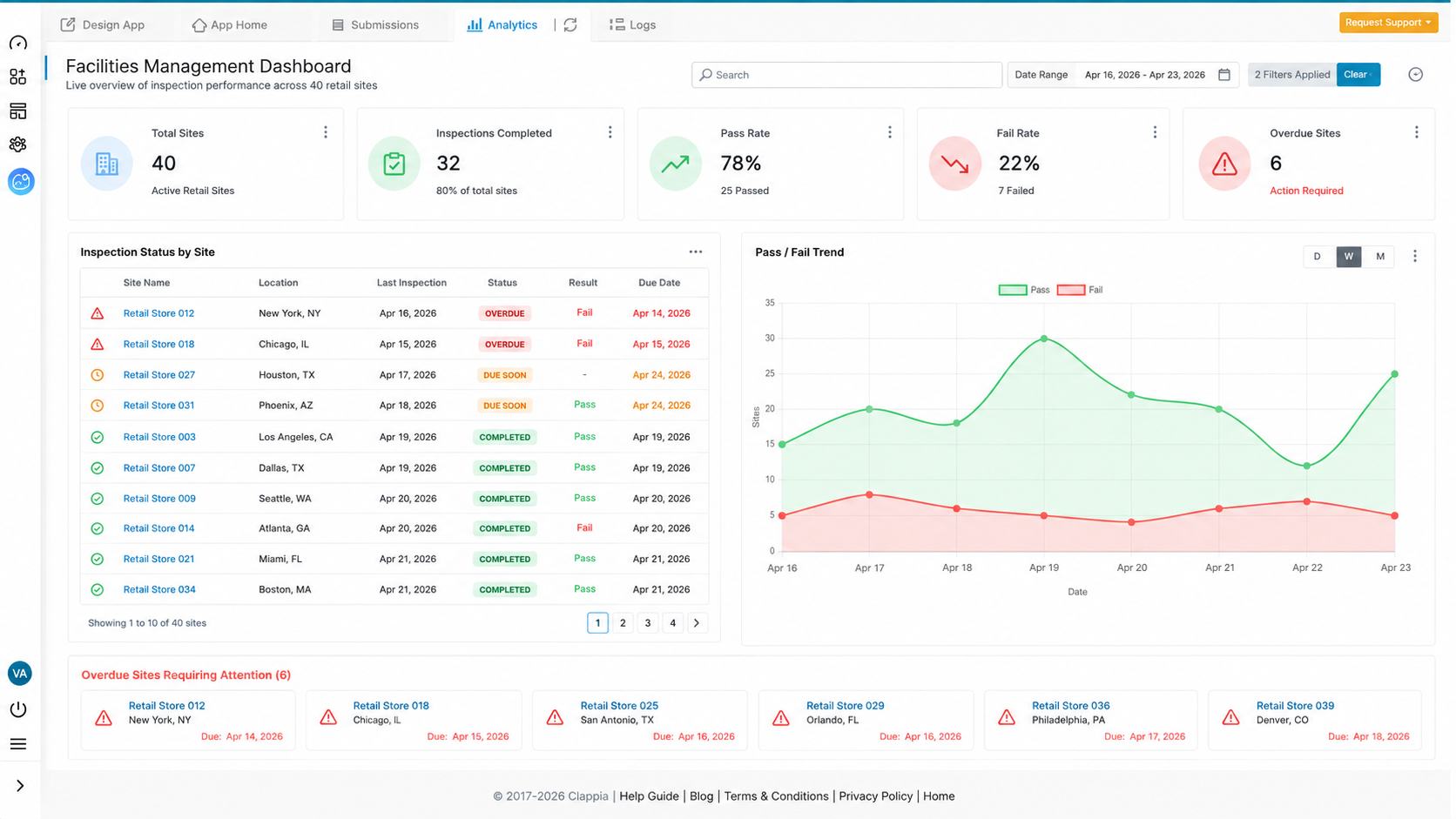
A facilities management company overseeing safety walk-throughs at 40 retail locations had no single view of which sites were current and which were overdue, since each regional manager kept a separate spreadsheet. Moving the walk-through to Clappia gave the operations team a live dashboard that rolls up every site's submission status, flags sites that have gone past their inspection interval, and routes any failed item through an approval workflow so a regional manager signs off before a corrective action is closed. What used to be a Friday-afternoon phone-call chase is now a single screen.
| Legacy tracking | Custom field inspection app |
|---|---|
| Paper forms or a static spreadsheet per site | One standardized digital checklist across every site |
| Photos live on inspectors' personal phones | Timestamped photos attached directly to the submission |
| No proof of where an inspection happened | GPS location with geofencing on every submission |
| Inspections stall without signal | Full offline capture, auto-sync on reconnect |
| Failed items chased by phone or WhatsApp | Automated approval workflow routes the fix instantly |
| Status known only after someone compiles it | Live dashboard flags overdue sites automatically |
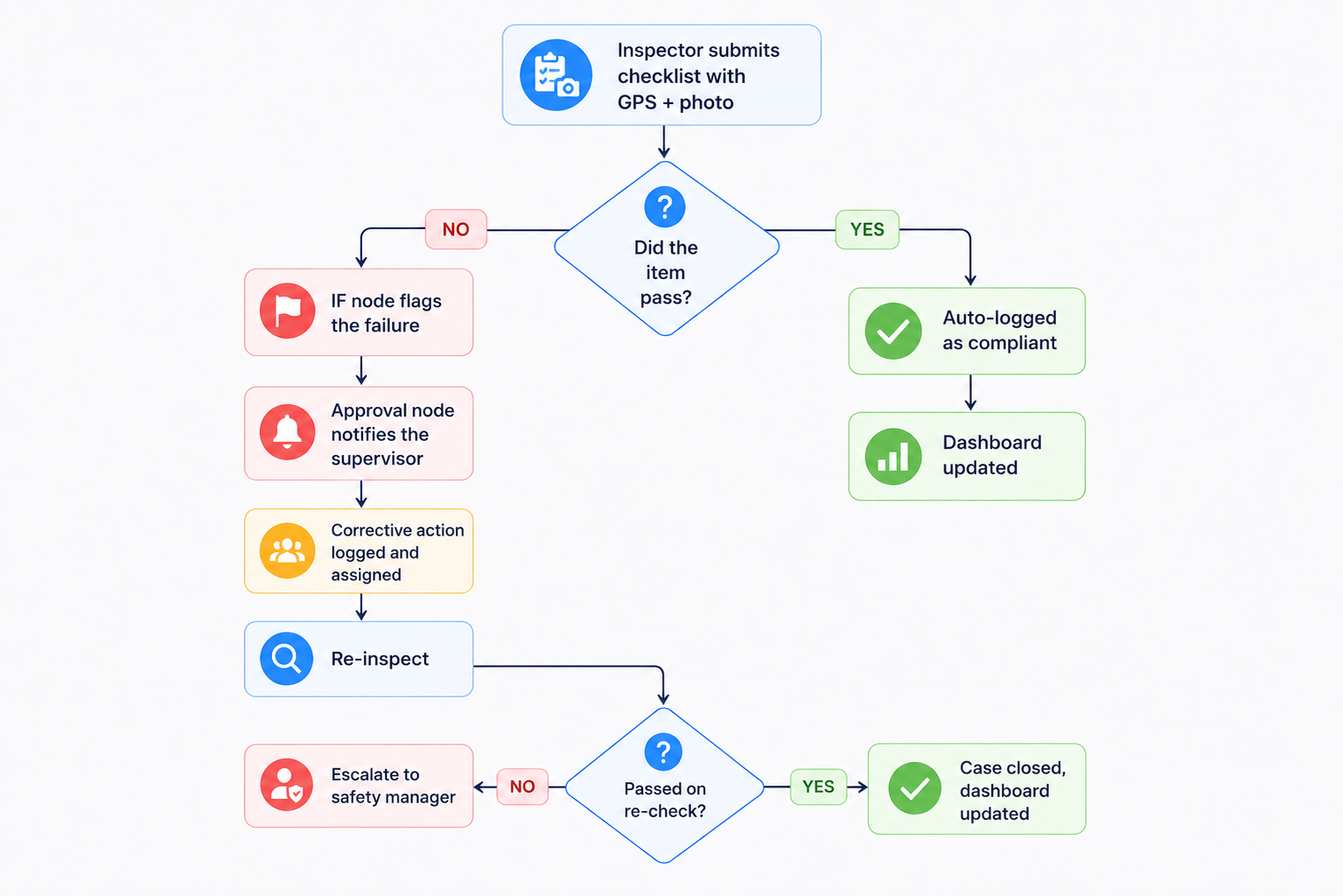
The pattern above matters because a fast handoff, not the inspection itself, is what shrinks the window a defect has to turn into a bigger problem. Teams that automate this handoff with a condition (IF) node checking the inspection result, paired with a separate IF node for the failing branch, get the corrective-action ticket into the right inbox in seconds instead of at the next shift meeting.
The step list above covers one failed item. In practice, a distributed inspection program is running that same decision for every submission, across every site, at the same time, which is why the routing logic below matters more than any single checklist.
For a closer look at how teams are already closing this gap, see our guides to the best offline inspection apps for field teams, the top checklist apps for inspections and audits, how to automate field inspection reports end-to-end, and Clappia's full feature set for field teams.
Three shifts stand out. First, offline-first mobile capture is becoming the baseline expectation, not a premium feature, since inspections routinely happen in basements, remote sites, or steel structures with no signal. Second, GPS and photo evidence tied to a specific submission are increasingly treated as compliance artifacts in their own right, not just nice-to-have context. Third, inspection data is moving out of static spreadsheets and into live dashboards that flag overdue sites automatically, closing the gap between when a problem happens and when the right person sees it.
Ready to see your own inspection data on one dashboard instead of forty spreadsheets? Start building for free and turn your next site walk into a GPS-tagged, photo-backed submission your team can act on the same day.
Federal OSHA conducted 30,273 inspections in FY 2025, according to the agency's enforcement summary, split roughly evenly between complaint-driven and planned emphasis-program visits.
Inspector coverage has thinned faster than the number of worksites has shrunk, with roughly one combined federal and state inspector for every 70,000 workers, which stretches the interval between government-triggered visits.
Teams typically cut inspection time from 30 to 45 minutes on paper down to 5 to 8 minutes digitally, a reduction that mobile inspection software studies put at roughly 60% of labor hours per inspection.
The baseline set is GPS location capture with geofencing, timestamped photo evidence, offline mode for low-signal sites, an approval workflow for failed items, and a live dashboard that rolls up status across every site.
Yes. Apps built with offline mode store submissions and photos on the device during the inspection and sync automatically once the device reconnects, which matters for basements, remote sites, and metal structures with weak signal.
 Get Started – It’s Free
L374, 1st Floor, 5th Main Rd, Sector 6, HSR Layout, Bengaluru, Karnataka 560102, India
3500 S DuPont Hwy, Dover,
Kent 19901, Delaware, USA


.svg)




3500 S DuPont Hwy, Dover,
Kent 19901, Delaware, USA
L374, 1st Floor, 5th Main Rd, Sector 6, HSR Layout, Bengaluru, Karnataka 560102, India